

Weight and pack size
Aside from the size when pitched, it’s worth checking out the packed down size. A tent’s good for nothing if you can’t carry it or store it back at home. For some types of travel, your tent’s weight and pack-down size are critical factors. If you’re backpacking, riding, canoe or cycle touring you’ll want something with that packs down small and lightweight to ensure you can get it in your rucksack or panniers and carry it easily.

Get the wrong size tent and you might need one of these to carry it
Photo: En route to Iceland
An extra kilo or two may not sound like a lot but believe me it feels like a lot if you’re carrying it on your back day after day. And while an extra litre of space may sound hardly worth worrying about, you may change your mind when you have to leave your spare chocolate bars, socks and fleece behind. Even when travelling by car pack size can make the difference between being able to get the rest of your gear in the boot or not. Back at home a small tent will be easier to store too.
Strength and durability
A good family tent needs to be strong and durable, not just to withstand the worst weather you are likely to face but also the stresses and strains of energetic kids. Cheaper tents tend to use cheaper zips, poles, pegs and tent material which may fail more easily when kids are bouncing around inside, zipping and unzipping, or over enthusiastically assembling and disassembling the tent. And of course if these things are going to fail, it will be in the middle of the night, during a storm when you’re miles from anywhere and your torch is dead.
If you’re looking for something that will last it may be worth paying a little extra for a more durable design or higher quality components. Look for rip stop materials, strong alloy pegs and poles, zips that run smoothly and don’t snag, fine but strong insect netting and strong guy ropes. And if you’re thinking of camping in snowy winter conditions make sure your tent is designed to withstand snowfall. I’m not being funny, while rain runs off a tent, snow settles and a few inches of snowpack can seriously collapse your tent if it’s not designed to withstand it.
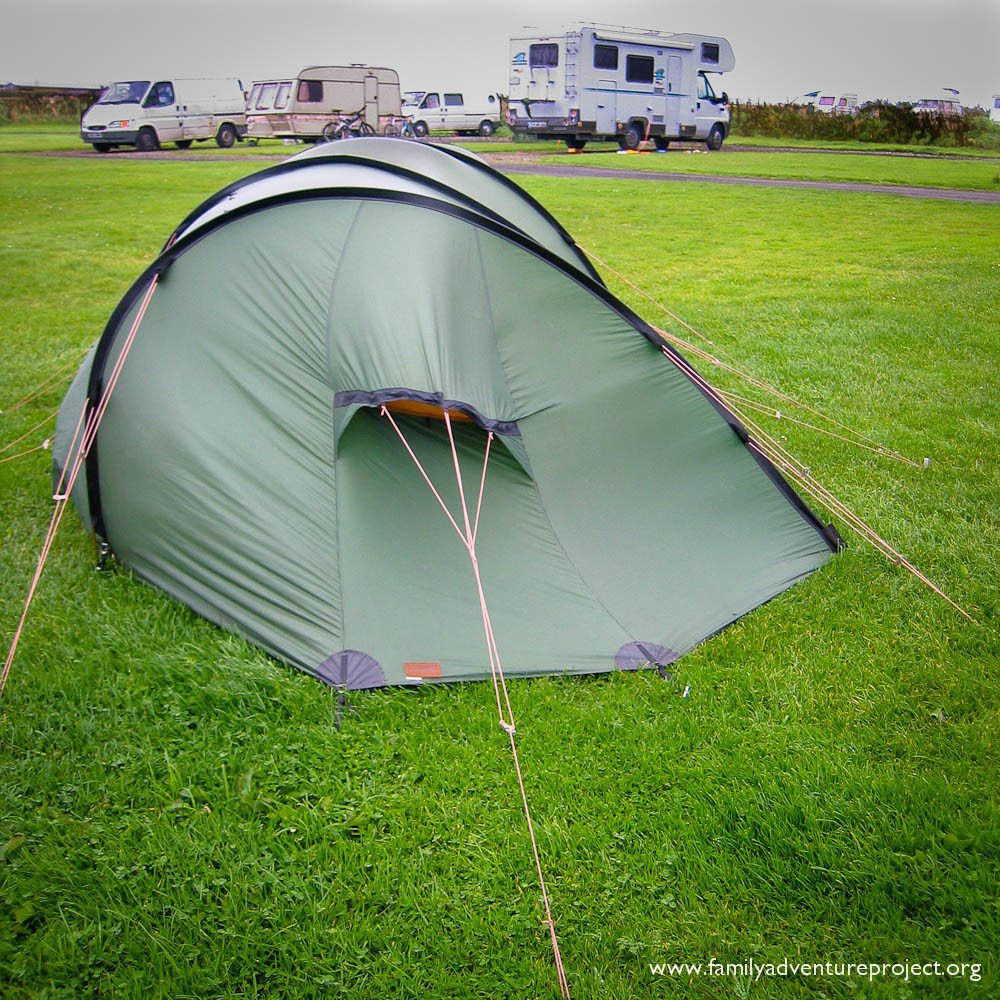
Make sure your tent is designed to cope with the worst conditions you anticipate
Photo: Completing Lands End to John O Groats
Waterproofing and ventilation
Do you want to stay dry? Well if you do, make sure your tent is waterproof, not just water resistant or shower proof. You may be surprised to learn that not all tents are built with this in mind; some are little more than sunshades.
There are technical single skin tent designs on the market these days, some using sophisticated materials technology to keep rain a materials width away from you. You’ll get best results and least condensation from materials that are ‘breathable’ but these are often expensive and perhaps not best suited to family camping where the risk of inadvertent toddler induced damage can be high!
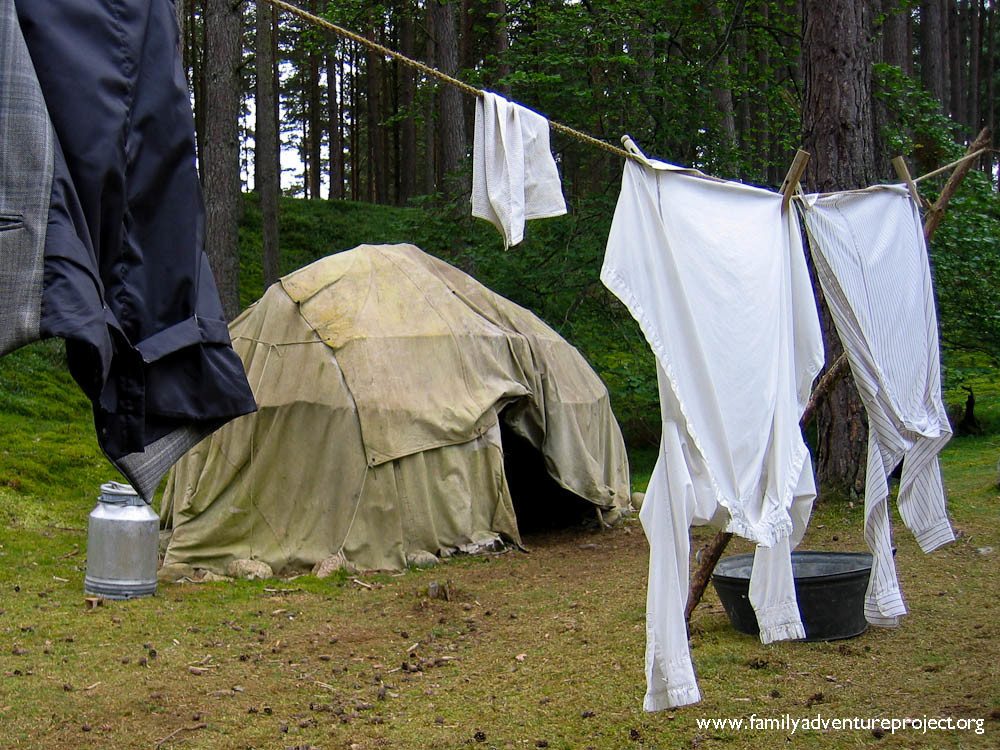
Tent technology has come a long way since this, basic but probably toddler proof.
For family camping you’ll probably get best results from a design with a separate inner and outer (or flysheet). And that way you won’t have to spend every cloudburst shouting at the kids not to touch the sides or worrying whether their pencil is about to pierce your Gore-Tex skin.
If you go for a two layer design, look for one where inner and outer pitch together as it will be quicker to put up and dismantle. Detachable or removable inners can be helpful for cleaning or separating things out if you have to dismantle on a wet day. Likewise you’ll really appreciate a design where you can pitch the outer first and then insert the inner if you find yourself pitching in the pouring rain.
Ventilation is a big part of keeping dry too. In poorly ventilated tents condensation inside the tent can be as much of a problem as rain penetrating from the outside so look for designs that are well ventilated or with ventilation you can adjust. It also comes in handy if someone inadvertently drops one in a confined space.
Next: Design & assembly. Read Page 4

A very comprehensive post !
We run a number of camping trips throughout the year and tempt along many first time campers. I always recommend to either buy second hand or borrow for their first visit, I’ve lost count of the number of people who head to Tesco and end up with a cheap tent that simply isn’t up to the job…..and if the weather’s bad, can end up putting them off for life.
I’ve had a number of tents over the years and have now graduated to a campervan, but still can’t help to get ‘tent-envy’ when I wander around a campsite.
Roll on camping season!
Chrissie x
Some of those campsites look fantastic! We went a bit fancy and bought ourselves a huge polycotton tent last year, not cheap, but worth the money.
A great post with perfect timing. Some ladies on a forum I moderate are talking about buying a first tent. I will pass this along to them!
Hi guys, thanks a lot for our brilliant post!!! You perfectly describe what we were thinking at: budget, dimension, stay dry…. actually we can’t wait to buy and start to camp!! Italy is summer 2013 destination…but still have to decide where!
Let’s keep in touch
Alessandra & the Toads Family
Many thanks for a really informative post. I’m in the market for a first-time family tent and your post has made me think about a couple of things I hadn’t previously considered.
Thank you!
Luke
Hi,
Glad I found this as I was searching the net about tents and wild camping and found this 🙂
Our family started camping for the first time this year and we love it. The weathers turning abit now, but the summer we’ve had has made it well worth while and perfect for camping.
We started off with a Quecha pop-up tent (we’re a family of 4) but recently had to change it due to some issues we had with it.
We’ve now changed it for a Vango Icarus 500 and I just wondered if anyone else has one of these tents and what they thought of it?
We’d also love to try wildcamping but are clueless as to where best to go and also if the tent we’ve now got is any good for the job.
If anyone has used this tent I’d love to hear your views.
Thanks 🙂
Can you please tell me what brand that 3 connecting tent design is? Thank you.
That was an Ozark Trail tent we bought from Walmart while in USA. Don’t know if they still make that model but there look to be similar designs from them. It was VERY heavy but very cheap.
It’s so easy to get carried away when buying a tent, when you start considering how many extra rooms you need besides the bedrooms! But unfortunately the bigger the tent the harder it gets to put it up, and that’s no fun with small children!
[…] the novices, so if you’re new to camping check out The Family Adventure Project’s great tips for buying a tent for family […]
So finally, is that a Hilleberg one the one you got?
We have had a few tents over the years but our Hilleberg Keron 4GT has been one of our stalwarts. Still going strong after 15 years of use and abuse.
Wow. So glad I found this. I’ve been battling with tent for days now. Your article and one from familytentcenter(dot)com are life savers.
[…] Buying a Tent for Family Camping | The Family Adventure Project […]
[…] Click to read our Gear Guide: Buying a Tent for Family Camping […]
[…] For tips on buying a tent for family camping – check out our Tent Buying Gear Guide […]
Ohhh, this is great. This really helps for me to find a family tent! Thank you.
[…] wanting to climb on top of each other. What? In our tent we’re already on top of each other. We bought our tent for family camping, when the kids were tiny. Back then we called it the ‘party tent’ because there was so much […]